Key Takeaways:
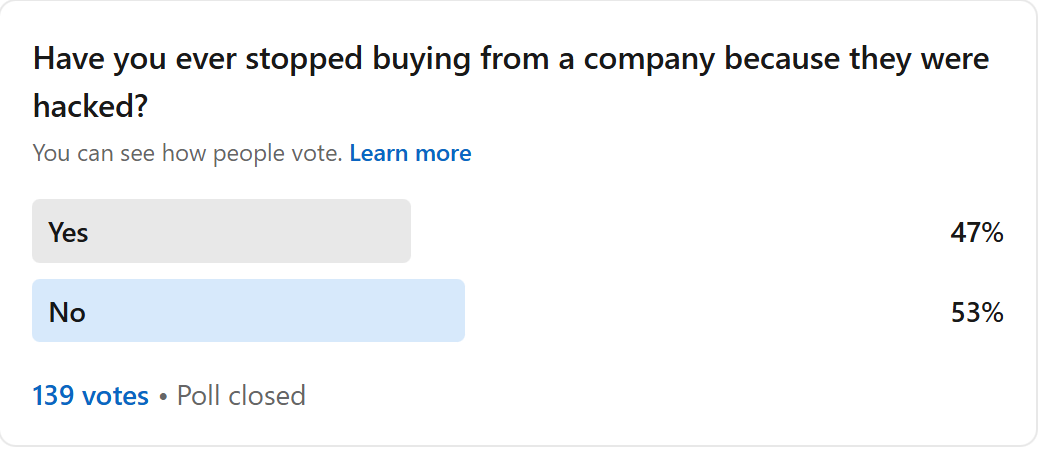
- In a LinkedIn poll, 47% of respondents said they have stopped buying from a company after learning it was hacked.
- Major companies like TalkTalk, Anthem, and MediSecure have lost customers, reputation, and millions of dollars in revenue after cyber incidents.
- Even with cyber insurance, businesses face long-term trust erosion, customer attrition, and competitive vulnerability.
- Breaches impact everything from brand value and hiring to future revenue and new customer acquisition.
- Small and mid-sized companies are often hit hardest, with up to 60% going out of business within six months after a major breach.
When a company gets hacked, the consequences go far beyond server downtime and incident response reports. One of the most critical but less quantified outcomes is customer flight. A recent LinkedIn poll posed a simple question: “Have you ever stopped buying from a company because they were hacked?” The result was sobering—47% of respondents said yes.
That statistic reflects more than momentary frustration. It points to a fundamental breach of trust that can damage a business for years, regardless of how quickly systems are restored or how many press releases are issued. And for some companies—especially small and midsize organizations—the damage can be permanent.
What Happens When Customers Walk
Customer trust is hard-earned and easily lost. When a company suffers a data breach, that trust evaporates quickly, and the ripple effects can be devastating. Consumers who once handed over their credit card information, personal data, or login credentials are suddenly reminded how vulnerable their information can be.
According to a Vercara study, 66% of U.S. consumers say they would not trust a company after a data breach, and three-quarters say they would consider switching to a competitor. That’s consistent with the LinkedIn poll result, which showed nearly half of respondents severing business ties over cybersecurity lapses.
This sentiment isn’t limited to consumers. In B2B markets, a single breach can cause procurement teams to blacklist vendors, cancel renewals, or halt pending deals. Once a company is perceived as a weak link in the supply chain, that perception is hard to shake.
Real-World Fallout
Several high-profile breaches illustrate how customer loss and reputational damage unfold in practice:
TalkTalk (UK, 2015)
A breach affecting over 150,000 customers caused massive churn. Within three months, TalkTalk lost 101,000 subscribers and approximately £60 million in cleanup costs and lost revenue. Regulators fined the company £400,000, and its brand took years to recover.
Anthem (U.S., 2015)
The health insurer exposed nearly 79 million customer records, including Social Security numbers and medical IDs. The incident resulted in a $115 million class-action settlement and lasting damage to Anthem’s reputation in the healthcare sector.
MediSecure (Australia, 2024)
After a ransomware attack leaked sensitive prescription data, the company collapsed within weeks. MediSecure went into administration, citing the financial and operational strain caused by the breach and subsequent fallout.
National Public Data (U.S., 2024)
A lesser-known but equally dramatic example, this data broker shut down permanently after a breach exposed nearly 3 billion records. The combination of legal pressure, reputational damage, and loss of client trust proved too much to overcome.
These cases demonstrate that while the technical aspects of a breach can be mitigated, the psychological and commercial effects are harder to control. Even a rapid recovery may not prevent customers from abandoning ship.
The Insurance Illusion
Cyber insurance plays an important role in helping organizations manage the financial risk of an incident. Policies can cover forensic investigations, legal defense, notification costs, and even ransom payments. But insurance cannot repair trust, erase headlines, or stop customers from walking away.
If customer data was leaked, no policy payout changes the fact that their information was exposed—and possibly misused. Public perception is driven by narrative, not nuance, and once a company is branded as careless with data, that label tends to stick.
Competitive Targeting
When a company is reeling from a breach, competitors often seize the moment. This can take the form of subtle advertising, direct outreach to clients, or even public campaigns emphasizing superior security posture. In industries like telecom, healthcare, or financial services, it’s common for competitors to cite “uncompromised security” as a differentiator in marketing materials—sometimes directly referencing recent incidents involving rivals.
In some cases, major accounts change hands not because the competitor offered a better product, but because they seemed safer. Security has become a core part of brand equity, and a breach can permanently erode that value.
Long-Term Brand Damage
The negative perception caused by a breach can last for years. According to Stanford research, the average recovery time for brand trust after a significant security incident is over three years. During that period, companies typically face higher churn, lower conversion rates for new customers, and elevated customer service costs as support teams deal with concerned users.
Recruiting also becomes harder. Top candidates may avoid joining companies with recent breaches, especially in fields like cybersecurity, product development, or legal. Existing staff may leave due to stress, reputational risk, or poor internal communication after the incident.
The Cost of Acquiring New Customers
After a breach, the cost of customer acquisition increases substantially. Companies must often invest in expanded marketing efforts, deeper discounts, and more frequent promotions just to maintain revenue levels. But these short-term tactics can erode margins and strain already-depleted resources.
In highly regulated sectors, a breach also raises the risk profile of a vendor. That can complicate compliance audits, slow down procurement, and limit growth.
Small Business, Big Risks
While large companies have the resources to weather reputational damage, small businesses are often devastated. Studies suggest that up to 60% of small businesses close within six months of a major breach. For companies relying on recurring revenue or trust-based relationships, even a small leak can cause contracts to be canceled and referrals to dry up.
When data loss lasts more than 10 days, the risk of bankruptcy jumps dramatically. Nearly 93% of small businesses unable to recover data within that window go out of business within a year.
Why It Matters
While not an official survey, the 47% figure should serve as a wake-up call. Cybersecurity is not just an IT issue or a regulatory hurdle—it’s a customer experience issue. It affects sales, marketing, support, hiring, retention, and the future of the business itself.
Organizations that invest in proactive defense, transparent communication, and rigorous incident response planning are better positioned to retain customer trust and bounce back. Those who don’t may find that the technical fix is only the beginning of the recovery process. Contact our 5-star IT support team to see how we can keep you secure.

 Apex Technology Services