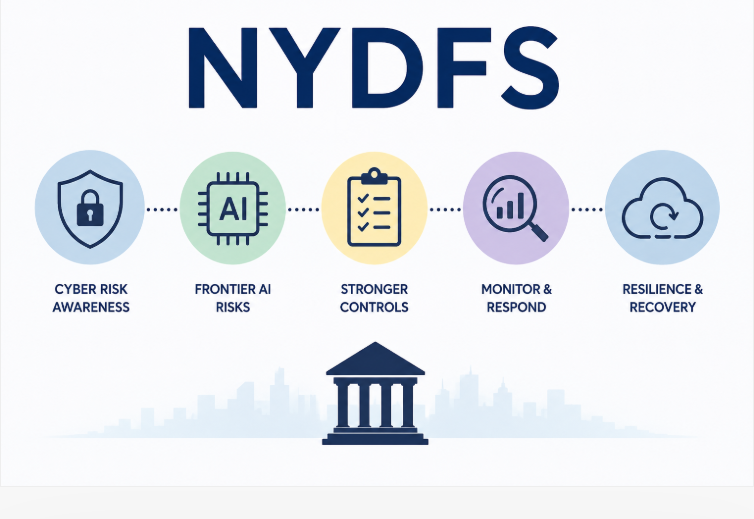
Key Takeaways:
- NYDFS is signaling that frontier AI may accelerate vulnerability discovery, exploit development, social engineering and other cyber risks.
- Regulated companies may need to revisit risk assessments, patching timelines, MFA, vendor oversight, logging, backups and incident response.
- Even companies outside direct NYDFS oversight could feel the impact through customer contracts, audits and third party risk requirements.
- Apex Technology Services can help organizations translate this type of guidance into practical cybersecurity readiness steps.
The cybersecurity conversation around AI is changing quickly. For the last two years, much of the business discussion focused on productivity. How can AI help employees write faster, summarize documents, automate support, improve workflows or reduce manual work?
That conversation is still important. But a more uncomfortable issue is moving into the foreground: AI may also make attackers faster.
That is the main point companies should take from the latest NYDFS guidance discussed by Davis Wright Tremaine LLP. The firm reviewed two May 2026 NYDFS industry letters addressing frontier AI cyber risk and broader heightened cybersecurity threat environments. The guidance is aimed primarily at entities subject to NYDFS cybersecurity regulation, including New York regulated financial institutions, insurers, brokers and certain virtual currency businesses. But the operational message applies more broadly. Organizations need to assume that the time between vulnerability discovery and exploitation may continue to shrink.
That is a big shift.
In the past, many companies treated patching, vendor reviews and incident response as important but manageable items on a long IT checklist. A critical vulnerability would be announced. The team would assess it. Internal owners would debate timing. Maintenance windows would be scheduled. Maybe a vendor would be contacted. Maybe the fix would wait until the next quarterly review.
AI makes that rhythm look increasingly outdated.
NYDFS warned that certain frontier AI models can “amplify the potency, scale, and speed of identifying vulnerabilities and exploits in information systems.” The agency also noted that while these capabilities may not yet be broadly available, they “may become more available soon.” That wording matters. Regulators are not waiting until AI enabled exploitation becomes routine. They are telling organizations to prepare now.
For business leaders, the practical question is not whether every attacker is using frontier AI today. The better question is whether your current security process is designed for a world where attackers can move faster than your internal workflows.
That is where many organizations may have a gap.
The NYDFS advisory highlights several areas that deserve immediate attention. Vulnerability management is one of them. Companies may need to revisit how they classify, prioritize and remediate known vulnerabilities. A vulnerability that seemed manageable under older timelines may become more urgent when AI can help attackers identify exploitation paths more quickly.
Third party risk is another major issue. Most organizations rely on outside software vendors, MSPs, cloud platforms, SaaS tools, payment processors, data providers and other service partners. NYDFS specifically points to coordination with critical third party service providers and supply chain providers. That includes identifying critical dependencies, reviewing threat intelligence, validating third party software code where appropriate and communicating vulnerability remediation expectations to providers.
This is not just a financial services problem. A company that sells into banks, insurers or other regulated businesses may face increased expectations even if it is not directly regulated by NYDFS. Those expectations may show up in contracts, security questionnaires, customer audits, procurement reviews and cyber insurance discussions.
Secure coding is another area moving into the spotlight. AI generated code can help development teams move faster, but speed can create risk if the output is not reviewed, tested and validated. NYDFS advises regulated entities to use additional testing and human oversight before AI generated code is deployed into production environments. That is a common sense recommendation, but it is also a reminder that AI should not become an uncontrolled path into critical systems.
There is also a monitoring issue. If attacks move faster, logging and alerting need to keep up. It is no longer enough to collect logs and hope someone reviews them later. Companies need to know whether their systems can detect suspicious behavior, escalate alerts, preserve evidence and support a coordinated response.
And then there is resilience. Backups, business continuity plans and incident response playbooks are often treated as things that exist somewhere in a folder. The real question is whether they work. Have backups been tested? Are they isolated from ransomware? Can the organization restore critical systems within realistic recovery timeframes? Has the company practiced an incident response scenario that includes AI accelerated exploitation or supply chain compromise?
These questions are not theoretical. Davis Wright Tremaine noted that NYDFS has historically followed guidance with targeted enforcement. The guidance itself may not create new legal requirements, but regulated entities could still be asked how they reviewed it, what decisions they made and whether their controls reflect the evolving threat environment.
The broader message is simple: cybersecurity programs need to become more adaptive.
Annual reviews are not enough. Static policies are not enough. A password policy sitting in a document is not enough. Companies need living security programs that can adjust as threats change, especially as AI becomes more capable and more accessible.
For many mid market organizations, this is where the challenge becomes practical. They know they need stronger MFA. They know they should patch faster. They know vendors need to be reviewed. They know backups should be tested. They know AI introduces new risks. But they may not have the internal staff, tooling or process maturity to turn all of that into an executable plan.
Apex Technology Services helps organizations approach this problem in a structured way. That can include reviewing risk exposure, tightening identity controls, improving endpoint and cloud security, validating backup and recovery readiness, assessing third party dependencies and helping leadership understand where AI changes the risk model.
This does not mean every company needs to rebuild its cybersecurity program from scratch. In many cases, meaningful progress starts with a focused assessment. Which systems are most critical? Which vulnerabilities are most exposed? Which vendors could create operational risk? Where is MFA still weak? Which logs are being collected but not acted on? Are backups actually restorable? Is AI being used by employees or developers in ways the company has not formally reviewed?
Those are the questions that move cybersecurity from theory to action.
AI will continue to help businesses operate more efficiently. It may also help attackers operate with more speed and precision. Both things can be true at the same time. The organizations that respond well will likely be the ones that treat AI cyber risk as part of their normal operating environment, not as a future issue waiting somewhere down the road.
For companies that serve regulated markets, handle sensitive data or depend on always on systems, the message from NYDFS is worth taking seriously. The clock is getting compressed. Security programs need to move faster too.

 Apex Technology Services