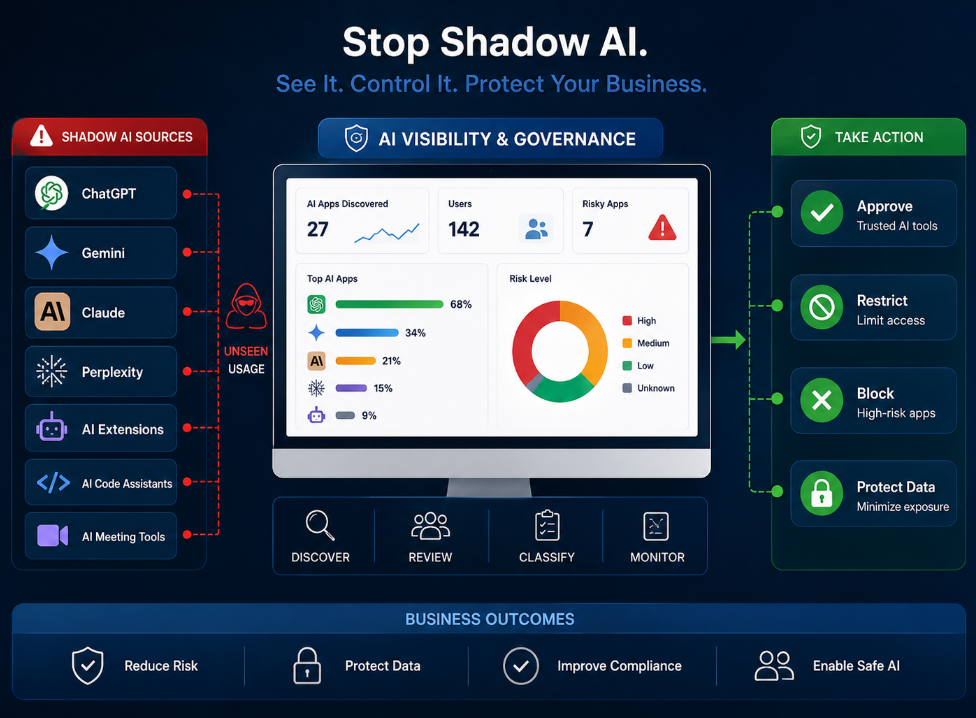
In a bustling New Jersey office, a stone's throw from Wall Street, a worker in a financial services company casually records conference calls on their personal device - only to upload these files for transcription to a third-party AI service. Management, compliance, regulatory bodies FINRA and the SEC remain blissfully unaware.
By 2026, Shadow AI has evolved from a fringe IT concern into one of the most urgent priorities facing enterprise leaders. For many CISOs and CIOs, it now outranks traditional cybersecurity threats because it is decentralized, difficult to detect, and capable of exposing sensitive corporate data at unprecedented speed and scale.
Unlike earlier forms of “Shadow IT,” where employees used unauthorized cloud storage or messaging apps, Shadow AI introduces a new category of risk: employees and departments embedding artificial intelligence tools directly into workflows without governance, oversight, or security review.
The result is a growing enterprise blind spot that carries significant financial, operational, and regulatory consequences.
A Nearly Universal Enterprise Problem
The scale of Shadow AI adoption has accelerated dramatically over the past year. Industry research now indicates that more than 80% of employees admit to using unapproved AI tools in the workplace. In many organizations, usage is happening faster than governance teams can respond.
What makes the issue especially dangerous is the visibility gap. While AI adoption has surged, only a minority of enterprises currently maintain formal policies or monitoring systems capable of identifying unauthorized AI usage across networks, applications, APIs, and endpoints.
This disconnect has created an environment where employees often deploy AI tools independently to improve productivity, automate workflows, or accelerate decision-making—frequently without understanding the security implications tied to those tools.
For enterprise leaders, the concern is no longer theoretical.
The Financial Cost of Shadow AI
The financial impact associated with unmanaged AI usage is becoming increasingly measurable.
According to the 2025 IBM Cost of a Data Breach Report, organizations with high levels of Shadow AI exposure experienced average breach costs of approximately $4.63 million—roughly $670,000 higher than organizations with mature AI governance frameworks.
That “breach premium” is becoming one of the clearest indicators that unmanaged AI environments create materially higher business risk.
Several factors contribute to these elevated costs:
- Sensitive intellectual property being entered into public AI models
- AI-generated code introducing vulnerabilities into production systems
- Unauthorized AI agents accessing internal systems and datasets
- Incomplete audit trails that complicate compliance investigations
- Expanded attack surfaces through third-party AI integrations
As AI adoption accelerates, the hidden costs associated with unmanaged usage are rapidly becoming an enterprise-wide issue rather than a departmental concern.
The Rise of Agentic AI Risks
One of the biggest shifts in 2026 is the emergence of autonomous or “agentic” AI systems operating inside enterprises.
Employees are no longer simply using chatbots to summarize emails or draft documents. Increasingly, they are deploying AI agents capable of performing persistent tasks autonomously, including:
- Monitoring inboxes
- Accessing databases
- Executing workflows
- Connecting to SaaS applications
- Generating code
- Making operational recommendations
These agents can operate continuously and at machine speed, often outside the visibility of traditional security tools.
This creates a new category of enterprise risk. Unlike conventional software deployments, AI agents may evolve behavior dynamically, interact with multiple systems simultaneously, and create chains of automated actions that are difficult to audit or contain.
Many legacy security architectures were never designed to monitor autonomous AI behavior, leaving organizations exposed to risks that traditional endpoint or network monitoring tools may fail to identify.
Data Leakage Has Taken on a New Meaning
Perhaps the most alarming aspect of Shadow AI is how enterprise data may be retained or reused by external AI systems.
Traditional Shadow IT risks generally involved unauthorized storage or transmission of information. AI systems introduce a more complex challenge because many public large language models retain prompts, interactions, or uploaded content for model improvement and training purposes.
This means employees may unknowingly expose:
- Proprietary source code
- Financial forecasts
- Customer records
- Legal documents
- Product roadmaps
- Internal strategy materials
Once entered into an external AI platform, organizations may lose visibility into where that data resides, how it is processed, or whether elements of it could surface in future outputs.
For heavily regulated industries—including healthcare, financial services, legal services, and government contracting—the implications are severe.
Regulatory Pressure Is Escalating
The regulatory environment surrounding AI governance has also tightened considerably.
With the EU AI Act and other global regulatory frameworks now entering active enforcement phases, unauthorized AI usage is no longer viewed solely as a cybersecurity issue. It is increasingly treated as a compliance and legal exposure.
Organizations that cannot demonstrate governance, accountability, and oversight over AI systems may face significant penalties, including fines tied to percentages of global revenue.
Boards and executive leadership teams are now asking security and compliance leaders new questions:
- Where is AI being used inside the organization?
- Which employees are using unauthorized tools?
- What data is being shared externally?
- Are AI systems auditable?
- Can the organization prove compliance?
For many enterprises, answering those questions remains difficult.
Why AI Bans Have Failed
Early attempts to ban generative AI usage across enterprises have largely proven ineffective.
Employees often view AI tools as productivity multipliers that help them complete tasks faster and remain competitive. As a result, strict prohibitions frequently drive usage underground rather than eliminating it.
Industry reports indicate that many employees continue using personal AI accounts even after formal bans are introduced.
This has forced enterprises to rethink their approach.
Rather than relying solely on restrictive policies, leading organizations are adopting governance models that balance enablement with security.
Emerging Enterprise Best Practices
Several strategies are emerging as effective approaches for managing Shadow AI risk without slowing innovation.
The “Fast Lane” Model
Many enterprises are introducing pre-approved tiers of low-risk AI applications that employees can use immediately.
By giving staff sanctioned options, organizations reduce the incentive for employees to seek unauthorized alternatives.
AI Discovery and Inventorying
Security teams are increasingly deploying specialized monitoring platforms capable of detecting AI-specific activity across:
- Browser extensions
- SaaS integrations
- API traffic
- Network communications
- Endpoint behaviors
This visibility layer has become critical for understanding the true scope of AI usage across the enterprise.
Enterprise-Safe AI Environments
Organizations are also investing in enterprise-grade AI environments where data submitted to models is explicitly excluded from public training pipelines.
Solutions such as private LLM deployments, sandboxed environments, and enterprise AI subscriptions are becoming standard components of corporate AI strategies.
The goal is to preserve AI-driven productivity gains while reducing the likelihood of sensitive data exposure.
Shadow AI Is Now a Board-Level Issue
What makes Shadow AI particularly significant in 2026 is that it intersects with virtually every enterprise priority simultaneously:
- Cybersecurity
- Compliance
- Data governance
- Operational efficiency
- Workforce productivity
- Digital transformation
- Corporate risk management
Organizations that fail to establish AI governance frameworks risk more than security incidents. They also risk undermining the return on investment tied to sanctioned AI initiatives.
In many enterprises, Shadow AI is effectively creating a hidden operational tax—one measured through elevated breach costs, fragmented AI adoption, duplicated tooling, and unmanaged compliance exposure.
The companies moving fastest now are not the ones attempting to stop AI adoption. They are the organizations building governance models capable of enabling AI safely, transparently, and at scale.
As enterprises continue integrating AI into daily operations, Shadow AI is rapidly becoming one of the defining governance challenges of the modern digital enterprise.
The team at Apex Technology Services continues to help clients with these challenges - reach out to learn more.
Aside from his role as CEO of Apex Technology Services and CEO of TMC, Rich Tehrani is CEO of RT Advisors and a Registered Representative (investment banker) with and offering securities through Four Points Capital Partners LLC (Four Points) (Member FINRA/SIPC). He handles capital/debt raises as well as M&A. RT Advisors is not owned by Four Points.
The above is not an endorsement or recommendation to buy/sell any security or sector mentioned. No companies mentioned above are current or past clients of RT Advisors.
The views and opinions expressed above are those of the participants. While believed to be reliable, the information has not been independently verified for accuracy. Any broad, general statements made herein are provided for context only and should not be construed as exhaustive or universally applicable.
Portions of this article may have been developed with the assistance of artificial intelligence, which may have contributed to ideation, content generation, factual review, or editing

 Apex Technology Services