Key Takeaways:
• Compromised credentials remain one of the common ways attackers gain access to business systems
• Security reports are useful only when they lead to action
• Businesses should ask whether their MSP monitors for exposed credentials tied to their domains and IPs
• Remediation may include password resets, username changes, MFA reviews, and account hardening
• A strong MSP process turns alerts into tickets, tickets into action, and action into reduced risk
A business does not always know when one of its credentials has been exposed.
There is usually no dramatic warning. No obvious system crash. No employee calling IT to say, “I think my password is floating around somewhere it should not be.”
More often, the warning arrives quietly.
It may look like a simple report:
“We detected 5 new compromised record(s) associated with your domain(s) or IP(s) for the time period of 04/01/26 to 05/01/26. This email contains links to the 10 most recently detected compromised records. The oldest record detected has an associated date of 04/15/26.”
That is not the kind of message most business owners want to see.
But it is also exactly the kind of message that should not sit in an inbox.
Compromised credential reporting has become an important part of modern cybersecurity. These reports can identify usernames, passwords, email addresses, or other account information that may have appeared in exposed datasets connected to a company’s domain or IP addresses.
Sometimes the data is old. Sometimes it is recent. Sometimes it points to an active user. Sometimes it reveals a forgotten account that should have been disabled months ago.
Either way, it deserves attention.
The challenge is that many businesses receive security information without having a clear process for what happens next. A report may be generated. An alert may be sent. A dashboard may show something that looks concerning.
Then what?
That is where the real difference begins.
A report is not remediation. An alert is not protection. A finding is only useful if someone reviews it, understands it, prioritizes it, and takes the right action.
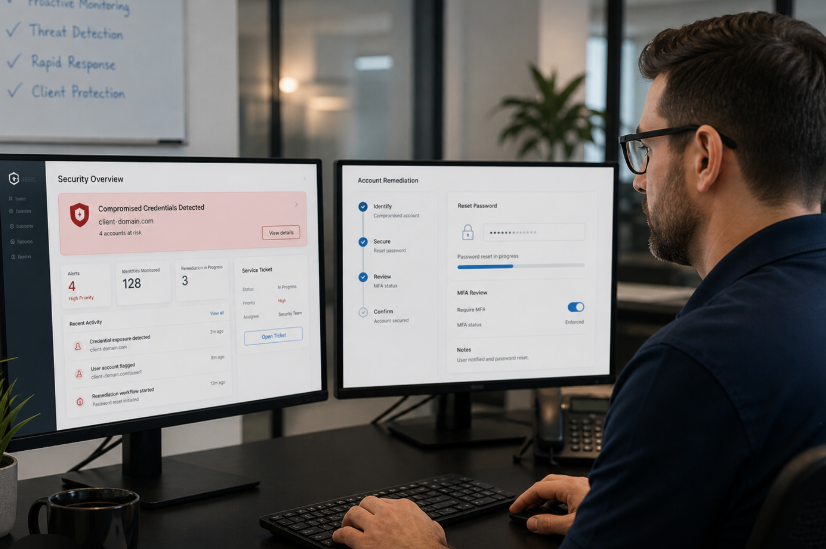
For many small and midsize businesses, that means working with an MSP that can turn security findings into operational tasks. When a compromised credential report comes in, it should become a ticket. The ticket should be reviewed. The affected account should be evaluated. The business should know whether the password needs to be changed, whether the username should be adjusted, whether MFA is enabled, and whether the account has more access than it should.
That may sound basic.
It is not always simple.
Employees reuse passwords. Former employees may still have access to systems. Shared mailboxes may have weaker protections than individual accounts. Vendors may have old logins. Cloud applications may be added without full visibility from IT. Over time, the identity layer of a business can get messy.
Attackers know this.
That is why stolen or exposed credentials are so useful to them. If an attacker can log in with a valid username and password, the activity may look normal at first. They may not need to break through the front door if someone has already left a key under the mat.
Here’s the thing: many cybersecurity issues start small.
One exposed password. One reused login. One inactive account that was never removed. One employee who used a work email address and the same password on another site years ago.
None of those sound like a crisis by themselves.
But they can become openings.
That is why compromised credential monitoring should be treated as part of normal cyber hygiene. It is not just a technical service. It is a business protection process.
A good process usually includes several steps.
First, monitor for compromised records tied to company domains and IP addresses. Second, review the findings to determine whether they are relevant, current, and connected to active users or systems. Third, create a ticket so the issue is tracked instead of forgotten. Fourth, remediate the problem through password changes, username updates, MFA review, account disabling, permission changes, or other steps as needed.
Finally, close the loop.
That last part matters. It is easy to generate alerts. It is harder to build a process that makes sure someone actually follows through.
For business owners and executives, the practical question is not whether every alert is catastrophic. Most are not. The better question is whether someone is watching and whether there is a repeatable process when something appears.
If you use an MSP, ask direct questions:
Do you monitor for compromised credentials tied to our domain?
Do these alerts become service tickets?
Who reviews them?
What remediation steps are taken?
Do you check whether MFA is active?
Do you help identify reused, stale, or risky accounts?
How do you document that the issue was resolved?
These are not scare tactic questions. They are reasonable operational questions.
In many cases, the fix may be straightforward. A password gets changed. MFA gets enabled. A user is notified. An inactive account gets disabled. Permissions are adjusted.
In other cases, the report may reveal a bigger issue. Maybe multiple employees are reusing passwords. Maybe offboarding is not being handled cleanly. Maybe the company has too many unmanaged accounts. Maybe the organization needs a broader identity and access review.
That is why this kind of reporting can be valuable beyond the individual alert. It can reveal patterns.
And patterns are where businesses can improve.
A single compromised credential report might help prevent a larger problem. A recurring set of reports may indicate that employees need better password practices, more consistent MFA, stronger offboarding procedures, or tighter control over which systems are tied to company email addresses.
For small and midsize companies, this can be difficult to manage internally. IT teams are often stretched. Business owners are focused on customers, employees, billing, operations, and growth. Cybersecurity becomes one more item on a long list.
But exposed credentials do not wait for a convenient time.
That is why MSPs play an important role. A strong MSP should not just keep computers running. It should help clients identify risks, respond to issues, and improve their overall technology environment over time.
Apex Technology Services works with businesses to help keep their technology running smoothly while supporting stronger cybersecurity practices. That includes using reporting tools, reviewing compromised credential findings, turning relevant reports into tickets, and helping clients remediate issues as needed.
The larger point is simple: cybersecurity reports should lead somewhere.
They should not sit unread. They should not be treated as noise. They should not create anxiety without action.
When handled correctly, a compromised credential report becomes part of a practical security workflow. Detect the issue. Create the ticket. Review the account. Take the right action. Confirm the work is complete.
That is not flashy.
But it is useful.
And in cybersecurity, useful often matters more than dramatic.
If your business already works with an MSP, ask whether compromised credential monitoring and remediation are included in your service. If the answer is unclear, it may be worth revisiting the conversation.
Because the risk is not just that a password was exposed.
The larger risk is that nobody noticed, nobody owned it, and nobody took action.

 Apex Technology Services