Key Takeaways:
• Hasbro disclosed a cyberattack that may take weeks to resolve
• Core systems were taken offline, with continuity plans activated to maintain operations
• The type of attack and scope of potential data exposure remain under investigation
• The incident reflects a broader trend of operational disruption, not just data theft
• Companies may need to rethink resilience, not just perimeter defense
It doesn’t take long. One moment, systems are running normally. Orders flowing, shipments moving, dashboards lighting up green. Then something trips. Quietly at first. And suddenly… parts of the business go dark.
That’s more or less what happened to Hasbro.
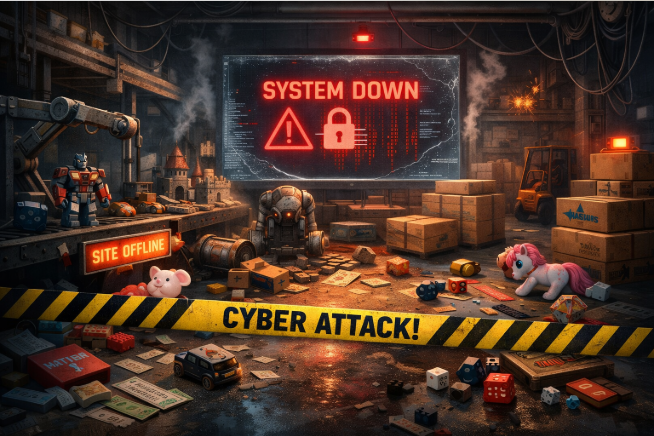
The company confirmed that it detected a cyber intrusion on March 28, prompting it to take portions of its systems offline. In a filing with the U.S. Securities and Exchange Commission, it acknowledged the disruption and warned that recovery could take “several weeks.”
Several weeks.
For a global brand with thousands of employees and a portfolio that includes Transformers, Peppa Pig, and Dungeons & Dragons, that kind of timeline is not trivial.
Here’s the thing. Cyber incidents used to be measured in terms of data loss. Today, they’re increasingly measured in operational paralysis.
And that’s a very different risk profile.
Hasbro said it “took swift action to protect our systems and data,” according to spokesperson Andrea Snyder. But at the same time, the company noted it is still implementing measures to secure operations. That detail matters. It suggests containment is ongoing, not complete.
Some of its web properties were down. Error messages pointed to maintenance. Behind the scenes, business continuity plans were activated so the company could still take orders, ship products, and keep key functions running.
But those are workarounds.
Not normal operations.
And that distinction is where the real cost begins to show up.
Because even if no sensitive data is ultimately found to be compromised, the disruption itself carries consequences. Delays. Friction. Potential revenue impact. Strain on partners and logistics chains.
So what kind of attack was it?
Right now, that’s unclear. The company has not confirmed whether it was ransomware, data exfiltration, or something else. It also said it does not yet know whether any data was stolen.
Which raises another question. How often do companies actually know the full scope of a breach in the early days?
It would be easy to treat this as a one-off. A big company, a bad day.
But that’s not really what’s happening.
Across industries, attackers have shifted toward models that combine data theft with operational disruption. Sometimes they encrypt systems. Sometimes they don’t. Sometimes they simply sit inside networks long enough to understand where maximum leverage exists.
Then they act.
A recent example often cited in the industry involved Jaguar Land Rover, where a cyberattack disrupted production lines for an extended period. The ripple effects reached suppliers, employees, and government stakeholders.
That’s the part many organizations still underestimate. These incidents don’t stay contained within IT.
They spill over into the physical world.
Factories stop. Shipments stall. Customers notice.
There’s a tendency to assume that large, established companies are inherently more secure. More resources. Bigger teams. Better tools.
But scale cuts both ways.
More systems. More integrations. More legacy infrastructure. More third-party dependencies.
More surface area.
Hasbro employs over 5,000 people and manages a complex ecosystem of digital and physical operations. That complexity doesn’t just create opportunity. It creates exposure.
And when something goes wrong, recovery is rarely instant.
That’s why “several weeks” stands out. Not because it’s unusual, but because it’s increasingly realistic.
This is where things get a little uncomfortable. Because most cybersecurity strategies are still built around prevention.
Keep attackers out.
But what if they get in anyway?
That said, the conversation may need to shift toward resilience. Not just how to stop an attack, but how to operate through one.
A few areas come into focus.
First, system segmentation. If one part of the network is compromised, can the rest continue functioning normally?
Second, recovery speed. Not just backups, but how quickly systems can be restored in a real-world scenario.
Third, operational continuity. Can orders still be processed? Can customers still be served? Even in degraded mode?
And fourth, visibility. Do you actually know what’s happening inside your environment in real time?
These are not new concepts. But incidents like this tend to expose the gap between theory and execution.
There’s another layer here. One that doesn’t always get discussed openly.
Cybersecurity is increasingly becoming a business continuity issue, not just an IT issue.
That changes how it should be managed. Who owns it. How it’s funded. How success is measured.
Because if an attack can disrupt operations for weeks, it’s not just about protecting data anymore. It’s about protecting the ability to function as a business.
And that’s a much higher bar.
The investigation is ongoing. Hasbro has brought in external cybersecurity professionals. Systems are being secured. Operations are continuing, albeit under interim measures.
More details will likely emerge over time.
But even without them, the takeaway is fairly clear.
Cybersecurity is no longer just about keeping secrets safe. It’s about keeping the lights on.
And for companies watching this unfold, the question isn’t whether something like this could happen to them.
It’s how they would operate if it did.
As phishing scams continue to grow in volume and subtlety, working with a quality managed services provider can help reduce risk. Firms such as Apex Technology Services focus on layered security, user awareness, and process discipline that can make these kinds of attacks easier to detect before money leaves the account. No system is foolproof, but thoughtful safeguards can make a costly mistake far less likely.

 Apex Technology Services